Whales: Giants of the Ocean

Whales: Giants of the Ocean

Whales are among the largest and most remarkable animals on Earth. These marine mammals live in oceans around the world, from warm tropical waters to the cold seas surrounding the poles.

Life Beneath the Surface

Although whales spend their lives in water, they breathe air through blowholes located on top of their heads. They must regularly return to the surface to breathe before diving again in search of food or traveling through the ocean.

Whales are warm-blooded, give birth to live young, and nurse their calves with milk. A thick layer of fat called blubber helps protect them from cold water and stores energy during long migrations.

Two Main Groups

Whales are generally divided into baleen whales and toothed whales. Baleen whales filter small animals from the water using flexible plates inside their mouths. This group includes blue whales, humpback whales, and gray whales.

Toothed whales use teeth to catch fish, squid, and other prey. Many of them also use echolocation, producing sounds and listening for returning echoes to understand their surroundings. Sperm whales, belugas, and orcas belong to this group.

The Blue Whale

The blue whale is the largest known animal to have ever lived. An adult can grow longer than a city bus and weigh well over one hundred tonnes. Despite its enormous size, it feeds mainly on tiny crustaceans called krill.

Communication and Migration

Whales communicate using clicks, whistles, pulses, and complex songs. Some sounds can travel across great distances underwater. Humpback whales are especially famous for their long, patterned songs.

Many species migrate thousands of kilometres each year. They often feed in cold, nutrient-rich waters before traveling to warmer regions where they mate and give birth.

Protecting Whales

Commercial hunting once caused severe declines in many whale populations. Today, whales also face threats from fishing gear, ship collisions, underwater noise, pollution, and changes to ocean ecosystems.

Conservation programs, safer fishing practices, protected habitats, and international cooperation can help whale populations recover. Protecting whales also supports healthier oceans because these animals play an important role in marine food webs and nutrient cycles.

Posted in Uncategorized

Great Pyrenees

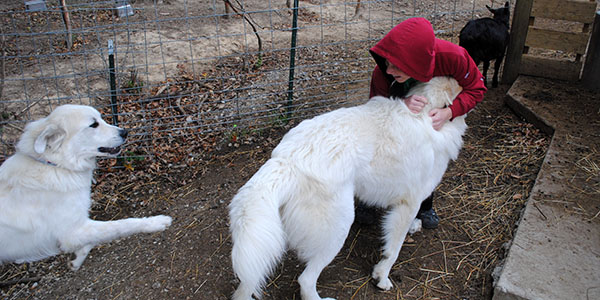
We have two dogs to guard our goats.  Their names are Thor and Baxter.  They are both registered Great Pyrenees. Because they are such great dogs, I wanted to learn more about the breed.

Male Great Pyrenees grow to 100–130 pounds and 27–32 inches, while the females reach 85–110 pounds and 25–29 inches. On average, their lifespan is 10 to 11 years.

Their main coat color is white, but they can have varying shades of gray, red, or tan around their face, ears, body, and tail. As Great Pyrenees mature, their coats grow thicker and the longer colored hair of the coat often fades. Sometimes a little light tan or yellow will appear later in life around the ears and face.

They are a double-coated breed, so the undercoat (while usually white) can also have color like the main coat does.  Under all that thick hair, their skin can have color as well.

Thor is all white except for a combination of red and yellow on his face, while Baxter is all white.

I’ve learned from experience that the Great Pyrenees’ coat needs brushing once or twice weekly (especially around the ears), otherwise their fur can get knotted.

The Great Pyrenees we have are very gentle (especially with us kids).

The breed needs regular exercise and tends to be somewhat lazy especially in warm weather. They really enjoy cold weather and snow.

Do you have Great Pyrenees?

Signature Fletcher


Posted in My life

Going to the vet

A vet is a place pets go for medical care. Taking  dogs to the vet can be easy or hard, (trained dog are technically easier) but it all depends on the dog and what it wants to do. We have two Great Pyrenees named Thor and Baxter.

This is what the vets did.

  1.  weigh them  
  2. ask questions
  3. look in ears
  4. feel bodies
  5. listened to heart
  6. took temperatures
  7. gave them shots
  8. answered questions

It looks like the dogs are happy to be back home!

DSC_1192_blog


Posted in Uncategorized

1 John 3:16

One of my favorite Bible verses is:

This is how we know what love is: Jesus Christ laid down his life for us. And we ought to lay down our lives for our brothers. 1 John 3:16

This past Sunday on our way home from church, we were driving down the highway, when we came upon a car crash. Colter blogged about the accident on his blog. The way people acted after the crash really reminded me of  1 John 3:16. I’m glad I’m a Christian and I want to have the chance to lay down my life for my brothers as God says to.

I asked Mom what it meant to lay down your life for your brothers. She said laying down your life for your brothers doesn’t always mean running into a fire to search for people.  It can simply mean putting their interests before your interests. I think running into a fire to search for people is probably easier.

Which one would you rather do?

Posted in Bible

Ten Reasons Why Big Families Rock!

I have 7  siblings so I’ve lived in a big family my whole life. I have found that there lot of advantages for big families.

Joans Disney Pics 2011 (361)

So I thought about it and made a list.

  1. You’re never bored.
  2. You have fun all the time.
  3. You have great times.
  4. You learn a lot.
  5. You have more people to split the chores.
  6. You get to say jokes a lot.
  7. You get a lot of presents.
  8. There are a lot of birthdays to celebrate.
  9. There are a lot of siblings to play with.
  10. You get lots of hand-me-downs.

What’s my favorites?  I like numbers 3 (You have great times) and 4 (You learn a lot).

What’s you’re favorite(s)?

Posted in My life

My Eighths

Mom doesn’t make us memorize a lot. But when she does, it’s something useful. And I just learned my eighths and recorded for you (and to prove it to mom).

Posted in Uncategorized